Magnificent Mile Architecture Tour
The Magnificent Mile is the one-mile stretch of North Michigan Avenue between the Chicago River and Oak Street that concentrates more landmark buildings per block than any other street in Chicago. It opens at the south end with the Wrigley Building and Tribune Tower facing each other across the river, passes the John Hancock Center (360 CHICAGO) at midway, and is anchored at the north end by the 1869 Chicago Water Tower — one of only a handful of masonry structures to survive the 1871 fire. This guide covers the architecture of the walk, the best guided tour options, and how to fit it into a Chicago itinerary.
The southern gateway: Wrigley Building and Tribune Tower
The Michigan Avenue Bridge (DuSable Bridge, 1920) at the Chicago River is the start of the Magnificent Mile and the single best vantage point on the route. Looking south from the bridge you see the full Chicago River canyon from inside it — the same view the river cruise gives you, from land. Looking north, the Wrigley Building and Tribune Tower frame the street in a composition that became the template for American boulevard architecture through the 1920s.
The Wrigley Building (1921-24, Graham Anderson Probst and White) uses white terra cotta cladding — 250,000 pieces — modeled on the Giralda tower in Seville. The surface was designed to reflect Michigan Avenue's street lights and glow at night. The two towers (north and south) are connected by a three-story colonnade at street level and a two-story bridge above; the different heights create an asymmetry that reads differently as you approach from the south versus the bridge.
Tribune Tower (1925, Howells and Hood) won a 1922 international design competition that drew 263 entries from 23 countries, including Eliel Saarinen, Walter Gropius, and Adolf Loos. The Neo-Gothic winning design was controversial at the time — the modernist entries were considered more technically advanced — but produced a tower that has aged better than many of its contemporaries. Embedded in the base of the tower are stone fragments from more than 140 world landmarks: the Colosseum, the Parthenon, the Great Wall, the Taj Mahal, Notre-Dame, the Berlin Wall. The fragments were collected by Tribune correspondents and editors over several decades.
Midpoint: 875 N Michigan (John Hancock Center)
The John Hancock Center — officially 875 N Michigan since its 2018 rename — was completed in 1969 by Bruce Graham and Fazlur Khan at SOM, the same team that later built Willis Tower. The building's exterior X-bracing (the black diagonal crosses visible on the facade) is structural, not decorative: the diagonals resist lateral wind forces that would otherwise require heavier interior framing. This made the building the first large-scale application of the exterior-tube structural system that Khan and Graham would refine into the bundled tube at Willis Tower four years later.
At 100 stories and 1,127 feet, the building sits at the midpoint of the Mag Mile walk. Its ground-floor arcade at street level and the public plaza on the Michigan Avenue side are part of the Mag Mile pedestrian experience even if you are not going up to 360 CHICAGO. The Hancock is also notable as a mixed-use building — residential apartments above the 44th floor, offices below, retail at the base — a program that was unusual at the time and has since been widely imitated.
The Chicago Water Tower: before the fire
The Chicago Water Tower at 806 N Michigan (1869, William W. Boyington) is one of only a handful of masonry structures in the city center to survive the 1871 Great Chicago Fire. The Gothic Revival limestone tower — originally housing a standpipe for the city's water system — is now a visitor information center and photography gallery. It sits next to the Chicago Pumping Station (also 1869, also Boyington), which is still operational as part of Chicago's water infrastructure. The two limestone Gothic buildings between the modern glass facades on either side of Michigan Avenue are the most direct architectural memory of pre-fire Chicago available on the Mag Mile.
Guided tour options
Several guided architecture tours cover the Magnificent Mile specifically or include it as part of a broader Loop and Mag Mile itinerary. The Chicago Architecture Center runs Mag Mile-focused walking tours with trained docents; the CAC's river cruise also includes the Mag Mile buildings visible from the water (Wrigley Building, Tribune Tower) from a different perspective.
Private architecture walking tours that cover the Mag Mile in depth are available through several operators on Viator; small-group and private formats allow you to set the pace and spend more time at specific buildings. Tours that combine the Loop and the Mag Mile in a single half-day are the most efficient format for first-time visitors.
Audio-guide options (CAC app, several third-party apps) work well for the Mag Mile because the route is linear and the buildings are widely spaced enough that GPS-triggered narration stays synchronized without ambiguity. The self-guided walk with a good audio guide is a viable alternative to a live-guide tour for most visitors.
Planning the walk
The Mag Mile is 1.0 miles from the Michigan Avenue Bridge to Oak Street. A straightforward north-to-south or south-to-north exterior walk takes 30-45 minutes without stops. Add 20-30 minutes for Tribune Tower base inspection, 15 minutes for the Water Tower, and another 30-45 minutes if you go up to 360 CHICAGO, and the walk becomes a 2-2.5 hour itinerary.
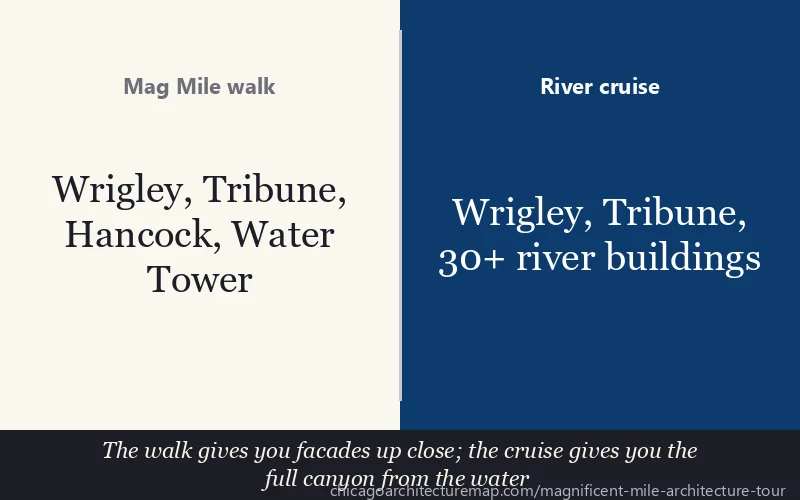
The natural architecture pairing is the Mag Mile walk plus the Chicago Architecture River Cruise on the same day: start with the cruise in the morning (which gives you the river view of the Wrigley Building and Tribune Tower from the water), then walk the Mag Mile north from the bridge in the afternoon. The two cover the same landmark buildings from opposite vantage points.
Weekday mornings have the thinnest foot traffic on the sidewalks. Saturday afternoons are the busiest — retail shoppers plus tourists — and the Mag Mile sidewalk between Tribune Tower and the Hancock can feel congested. If the architecture is the primary goal, aim for a weekday morning or early afternoon.
Top tours on the Chicago Architecture River

Chicago River 45-Minute Architecture Tour from Magnificent Mile
Selling outFree cancellation
Chicago City Tour with Architecture River Cruise Option
Selling outFree cancellation
Chicago Art Deco Madness Walking Tour
Selling out
Magnificent Mile Scavenger Hunt: Chicago Walking Tour and Game
PrivateFree cancellation
Chicago Perfume Making Classes on Magnificent Mile
Free cancellation
Magnificent Mile Tour With Optional 360 Chicago Upgrade
Free cancellation
Chicago Walking Tour: The Magnificent Mile
Free cancellation
Chicago Candle Making Class On Magnificent Mile
Free cancellation
Chicago Willis Tower Skydeck Ticket and Audio Tour with City Walk
Private
Chicago Architecture River Tour & Hop-on Hop-off Sightseeing Tour
Free cancellationFrequently asked questions
What is the Magnificent Mile in Chicago?
The Magnificent Mile is the one-mile stretch of North Michigan Avenue between the Chicago River (Michigan Avenue Bridge) and Oak Street. It is anchored at the south by the Wrigley Building and Tribune Tower, passes the John Hancock Center (360 CHICAGO) at midway, and ends at the north with the 1869 Chicago Water Tower — one of the few buildings to survive the 1871 Great Chicago Fire. The street concentrates more landmark buildings per block than any other corridor in Chicago.
Is the Magnificent Mile walk free?
Yes — the exterior walk along North Michigan Avenue is entirely free. The Chicago Water Tower visitor center is free to enter. Tribune Tower's embedded stone fragments in the base are viewable from the public sidewalk at no charge. The Wrigley Building's street-level colonnade is publicly accessible. Paid experiences on the route include 360 CHICAGO (observation deck at the Hancock, approximately $30 per adult) and guided walking tours from the Chicago Architecture Center (from approximately $25).
What architecture can you see on the Magnificent Mile?
The Wrigley Building (1921-24, Graham Anderson Probst and White): white terra cotta twin towers modeled on Seville's Giralda. Tribune Tower (1925, Howells and Hood): Neo-Gothic with stone fragments from 140 world landmarks embedded in the base. 875 N Michigan / John Hancock Center (1969, SOM): exterior X-braced steel tube with 360 CHICAGO observation deck on the 94th floor. The Chicago Water Tower and Pumping Station (1869): Gothic Revival limestone survivors of the 1871 fire.
How long does it take to walk the Magnificent Mile?
The exterior walk from the Michigan Avenue Bridge to Oak Street is 1.0 mile and takes 30-45 minutes at a comfortable pace. Add stops at Tribune Tower's stone fragment base (15-20 min), the Chicago Water Tower (15 min), and 360 CHICAGO if you go up (30-45 min) and the full itinerary runs 2-2.5 hours. The most efficient pairing: Architecture River Cruise in the morning (covers Wrigley and Tribune from the water), Mag Mile walk north from the bridge in the afternoon.
What is the best Magnificent Mile architecture tour?
The Chicago Architecture Center runs guided Magnificent Mile walking tours with trained docents covering the route's key buildings in 90 minutes. Private and small-group architecture tours on Viator allow you to combine the Mag Mile with the Loop in a single half-day. The CAC river cruise covers the Wrigley Building and Tribune Tower from the water before you walk the street-level route, giving you both perspectives in one day.
Is the Chicago Water Tower worth seeing?
Yes. The Water Tower (1869, William W. Boyington) is one of only a handful of pre-fire masonry structures surviving in the city center and provides direct architectural contrast with the glass towers surrounding it on Michigan Avenue. The visitor center inside is free and includes a photography gallery. The Pumping Station across the street is the same architect and same year and still operational as part of Chicago's water infrastructure — both Gothic limestone buildings are worth the 15-minute stop.