Chicago Loop Architecture Walking Tour
The Chicago Loop is the block where American architecture reinvented itself after the 1871 fire. Within a roughly ten-block radius of State and Madison streets you can walk from the 1885 Home Insurance Building site (the first steel-frame skyscraper) through Burnham and Root, Louis Sullivan, and Mies van der Rohe to Helmut Jahn. No other block in an American city has that compressed a timeline.
This guide covers the key buildings on a self-guided or guided Loop walking tour, the free and paid tour options, and how to plan an itinerary that covers the architectural sequence without backtracking.
What makes the Loop architecturally significant
The Great Chicago Fire of 1871 destroyed roughly 17,000 buildings across four square miles of the city center. The rebuild gave a generation of architects a blank site and a client base — insurance payouts and a booming commodity economy — willing to pay for experiments. The result was the Chicago School: steel-frame construction that separated the building's structural system from its exterior skin, allowing taller buildings and larger windows than masonry bearing-wall construction had permitted. Every glass-curtain-wall office building built since owes its logic to what happened in the Loop between 1880 and 1910.
The second Chicago School emerged after World War II when Mies van der Rohe arrived at IIT. His Federal Plaza buildings and the Illinois Institute of Technology campus introduced rigorous steel-and-glass Modernism that influenced corporate architecture worldwide through the 1970s. The contrast between Sullivan's ornamental terra cotta and Mies's restrained structural frames — two blocks apart on State Street — is the clearest object lesson in architectural history available on a single walk.
Key buildings on the walking tour route
The Rookery (1888, Burnham and Root) — 209 S LaSalle Street. The building's name comes from the temporary City Hall that stood here after the fire, which was so overcrowded with pigeons it was called the rookery. The current building has a granite-and-red-brick facade and a Frank Lloyd Wright-remodeled interior light court (1905) with white marble and gold-leaf detailing that is widely considered the most beautiful commercial interior in Chicago. The lobby is publicly accessible during business hours at no charge.
Monadnock Building (1891-93, Burnham and Root / Holabird and Roche) — 53 W Jackson Boulevard. The north half (1891, Burnham and Root) is one of the last major load-bearing masonry skyscrapers: its walls are six feet thick at the base to support 16 stories of brick. The south half (1893, Holabird and Roche) uses the new steel-frame system and has visibly thinner walls. Walking from one half to the other is the clearest physical illustration of the structural transition that defined the Chicago School.
Sullivan Center (formerly Carson Pirie Scott, 1899-1904, Louis Sullivan) — 1 S State Street. Sullivan's ornamental cast-iron work wrapping the ground-floor entrances is the most studied surface in Chicago architecture. The organic, branching designs preceded Art Nouveau in Europe and influenced every decorative movement that followed. The upper floors are restrained white terra cotta — Sullivan's "form follows function" principle visible floor-by-floor.
Chicago Board of Trade (1930, Holabird and Root) — 141 W Jackson Boulevard. The Loop's best Art Deco interior: a trading floor with geometric terrazzo and a bronze Ceres statue (goddess of grain) on the roof. The 1980 addition by Helmut Jahn added a glass-curtain atrium that mirrors the 1930 facade. Standing at the south end of LaSalle Street looking north, with the Board of Trade at the vanishing point, is one of the canonical Chicago views.
Federal Center (1959-74, Mies van der Rohe) — Dearborn between Adams and Jackson. Three buildings: the Everett Dirksen Federal Building, the John C. Kluczynski Federal Building, and the Post Office. Mies's mature steel- and-glass Modernism at full scale: exposed black steel structure, floor-to-ceiling glass, plazas designed to set the buildings off from the street grid. Alexander Calder's red Flamingo sculpture in the plaza is the deliberate counterpoint to Mies's geometric restraint.
Guided vs self-guided tours
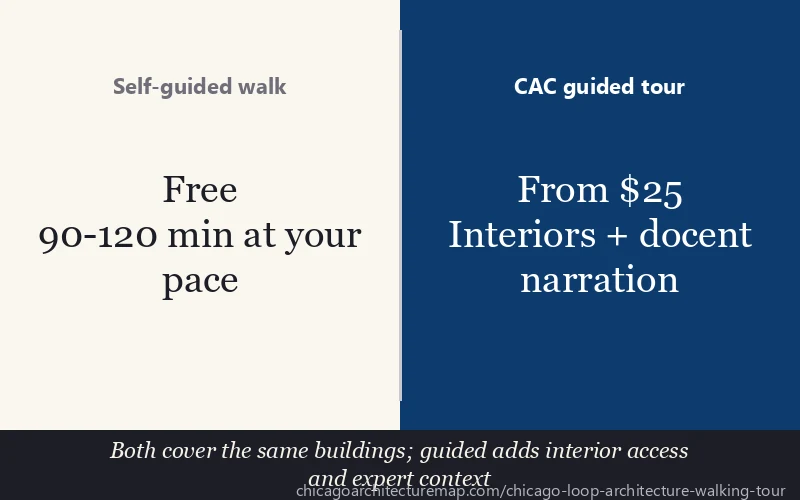
The Chicago Architecture Center (CAC) at 111 E Wacker Drive runs guided Loop walking tours with trained docents, typically covering 10-15 buildings in 90 minutes. The docents are CAC volunteers who complete the same multi-week training program as the First Lady river cruise narrators. Tours depart multiple times daily in peak season; booking in advance is recommended for weekend slots.
Self-guided walking is entirely feasible. The CAC's website publishes free walking tour maps for the Loop, the South Loop, and several neighborhood routes. The Architectural Tours app (iOS and Android) provides audio narration keyed to GPS position for several Chicago routes including the Loop.
The primary advantage of a guided tour is the interior access on some tours: the Rookery light court, the Chicago Cultural Center's Tiffany dome, and the Board of Trade lobby are on several guided itineraries and produce a meaningfully different experience than the exterior-only self-guided walk. The CAC also runs boat tours and evening tours; the river cruise is a separate booking.
Planning the route
A focused Loop architecture walk covers roughly 1.5 miles. The natural starting point is the CAC at 111 E Wacker Drive (Chicago River and Michigan Avenue), which gives you context before you enter the Loop grid. From there, the sequence that minimizes backtracking:
East along Wacker to State Street, south on State past Sullivan Center to Jackson, west on Jackson to the Board of Trade at LaSalle, north on LaSalle past the Federal Center and the Rookery to Adams, east on Adams to Dearborn and the Monadnock Building. The Cultural Center (77 E Randolph) and Millennium Park (Michigan Avenue) are natural endpoints on the east side if you want to extend the walk. Total walking distance with detours: 2-2.5 miles, 2-3 hours for a thorough visit including interiors.
Weekday mornings (9am-noon) give you the buildings when the lobbies are open and the streets are navigable. Weekend afternoons have heavier foot traffic on State Street but more open public spaces. The Rookery interior is accessible during business hours on weekdays; check hours before planning a Saturday visit.
Top tours on the Chicago Architecture River

Chicago Architecture Walking Tour: Incredible Art Deco Interiors
Selling outFree cancellation
Private Chicago Architecture Walking Tour
Selling outPrivateFree cancellation
Original Chicago Architecture Interiors Tour: Dazzling Interiors
Free cancellation
Chicago Art Deco Madness Walking Tour
Selling out
Private Architectural Walking Tour in Chicago Loop Landmarks
Selling outPrivateFree cancellation
Chicago Architecture Tour: Underground Pedway and the Loop
Free cancellation
Chicago Walking Tour: Art Deco Skyscrapers Loop
Free cancellation
History and Architecture of Chicago Loop Walking Tour
Free cancellation
Chicago Early Skyscraper Walking Tour in the Loop
Special offerFree cancellation
City Cruises Chicago: River Architectural Lunch Cruise
Free cancellation
Chicago City Tour: Elevated Architecture Tour with Train Ticket Included
Free cancellation
History of the Jazz Age at Chicago Art Deco Architecture Tour
Free cancellationFrequently asked questions
What is the Chicago Loop architecture walking tour?
A self-guided or guided walk through the Chicago Loop covering the buildings that defined American commercial architecture from 1880 to the present: the Rookery (Burnham and Root, 1888), Monadnock Building (1891-93), Sullivan Center (Louis Sullivan, 1899), Chicago Board of Trade (1930), Federal Center (Mies van der Rohe, 1959-74), and dozens of supporting buildings. The Chicago Architecture Center runs guided versions with trained docents; self-guided walks using CAC maps are free. A typical loop covers 1.5-2 miles in 90-120 minutes.
Are there free architecture walking tours in Chicago?
Yes. The Chicago Architecture Center (111 E Wacker Drive) publishes free self-guided walking tour maps for the Loop, South Loop, and several neighborhood routes on its website. The CAC also runs free public programs periodically, particularly during Open House Chicago in October when dozens of buildings open their interiors to the public at no charge. Paid guided tours with CAC docents start from approximately $25 per person.
How long does a Chicago Loop walking tour take?
A focused exterior-only walk covering the main buildings takes 90-120 minutes at a moderate pace. Adding interior visits to the Rookery light court, Chicago Cultural Center, and the Board of Trade lobby extends the walk to 2.5-3 hours. Guided CAC tours are typically 90 minutes for the walking-only format. The route is compact: the core buildings sit within a 10-block radius of State and Madison.
What are the best buildings to see on a Chicago Loop walking tour?
The Rookery (1888, Burnham and Root) for Frank Lloyd Wright's remodeled light-court interior. The Monadnock Building (1891-93) for the side-by-side comparison of masonry and steel-frame construction. Sullivan Center (1899, Louis Sullivan) for the ornamental cast-iron ground-floor work. The Chicago Board of Trade (1930) for Art Deco and the LaSalle Street canyon view. Federal Center (1959-74, Mies van der Rohe) for the Chicago School's second-generation modernist conclusion.
Is the Chicago Architecture Center worth visiting?
Yes — the CAC at 111 E Wacker Drive is free to enter and has scale models, building histories, and exhibits on Chicago architecture that provide useful context before a walking tour. It is also the departure point for most guided walking and river tours. The Chicago Architecture Foundation's First Lady river cruise (the most-reviewed Chicago tour on Viator) departs from the CAC dock.
What is Open House Chicago?
Open House Chicago is the Chicago Architecture Center's annual festival (typically the third weekend of October) during which 250+ buildings across the city open to the public at no charge, including many commercial interiors that are otherwise closed. It is the single best opportunity to see the Loop's private building lobbies, mechanical floors, and rooftop spaces. Tickets are free; some buildings require advance reservations that open in September.